Casimir Canel: Shot at Dawn, a Child of Avesnes-le-Comte
Avesnes-le-Comte · Series 24000 · Figures & Destinies
Casimir Canel The Broken Honor of a Child of Avesnes
1896–1917 · Military justice · Memory
Casimir Canel was not fighting for an abstract nation but for a land physically occupied. His execution as an example, and the penalty inflicted on his family, tell the price of military justice in wartime.
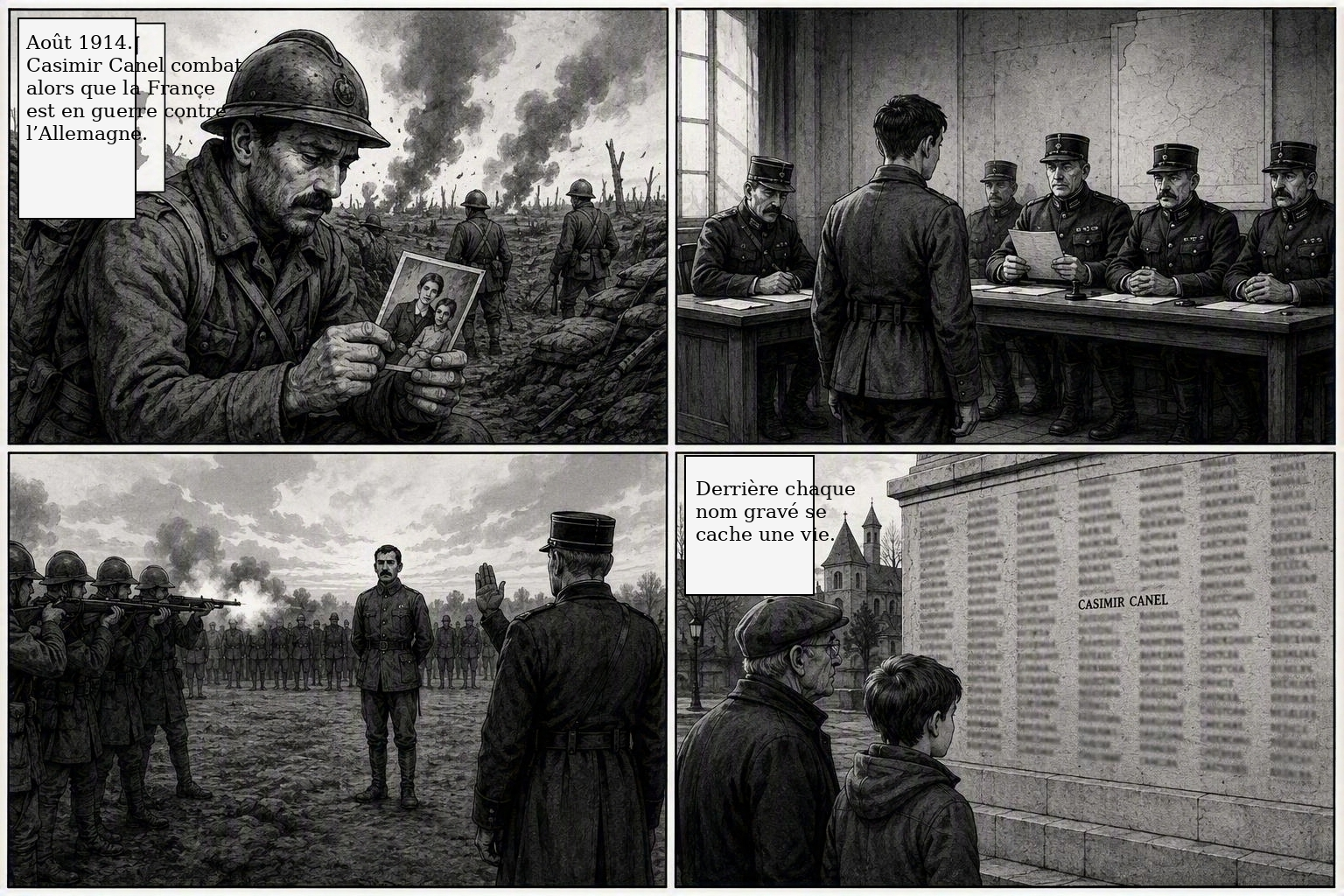
Casimir Canel (born 1 March 1896), a soldier of Avesnes-le-Comte, was executed in 1917, aged 21, one of the victims of the Chemin des Dames mutinies, after a war council judged him guilty of desertion for missing roll call; his memorial rehabilitation was celebrated on 20 November 2025. The mention “shot by order” deprived his widow and orphans of their status as Wards of the Nation and of any pension. Never legally pardoned, his rehabilitation is now one of memory.
Military justice and the price of an example. An analysis of military records reveals that the men of Avesnes-le-Comte went to the front with a unique psychological burden. Integrated into regional regiments, they knew as early as August 1914 that their homes were held captive under the enemy’s boot. Casimir Canel carried this alienation with him: he was not fighting for an abstract nation but for a land that was physically occupied.
Archive from the Canel file: a document testifying to the implacable mechanics of a military justice system pressed by the urgency of the front.
Section I
The judicial mechanics of execution
The execution of Casimir Canel was not an isolated aberration but the product of an exceptional system. Under the state of siege decreed in August 1914, the protections of the Military Justice Code vanished. Deprived of a preliminary investigation, Canel faced a special war council where the materiality of the facts — his absence at roll call — was enough to constitute the crime of desertion at his post.
In this crucible of tactical confusion, the justice system discarded any mitigating circumstances related to shell shock or family despair. Truth was not the goal; immediate exemplarity was. An “example” had to be made to stem the real or perceived panic among the troops.
Section II
The firing-squad ritual and symbolic erasure
The staging of Canel’s death was orchestrated to terrorise the survivors. The regiment, arranged in a “U” shape, became a visual accomplice to the State’s killing. After the reading of the sentence and the coup de grâce, the administration triggered the process of symbolic erasure.
Section III
The double penalty: family infamy
The mention “Shot by order” on the death certificate was a perpetual sentence. It deprived his widow and orphans of their status as “Wards of the Nation” (Pupilles de la Nation) and of any war pension. On the Liberation in 1918, Canel’s name became synonymous with betrayal for some, forcing his descendants into a lifelong struggle to restore his honour.
Section IV
A Kubrickian fate
Canel’s story resonates with the archetype of the soldier “shot at dawn” that has permeated 20th-century culture, from the arbitrary scenario of Stanley Kubrick’s Paths of Glory to the quest for truth in the works of Japrisot. His fate illustrates the rift between rank-and-file men and a high command obsessed with discipline.
Though never legally pardoned, his rehabilitation is now one of memory. By remembering him, we recognise the human distress at the front and the price paid by those whose will was shattered by the horror.
Frequently asked questions
A soldier of Avesnes-le-Comte executed by firing squad during the First World War as an example, after being judged guilty of desertion at his post.
The mention “shot by order” on the death certificate deprived his widow and orphans of their status as Wards of the Nation and of any war pension, and left his descendants a lifelong struggle to restore his honour.
He was never legally pardoned; his rehabilitation is now one of memory.
In 1917, aged 21 (he was born on 1 March 1896), as one of the victims of the Chemin des Dames mutinies. A ceremony of memorial rehabilitation took place on 20 November 2025 in the French military plot of Avesnes-le-Comte.
BDIC archives: League of Human Rights files (legal revisions).
Ministry of the Armed Forces: “Mémoire des Hommes” file — soldier Casimir Canel.
Historiography: research by Nicolas Offenstadt on soldiers executed as examples.
Local records: Series 24000 (International Genealogy Project).